
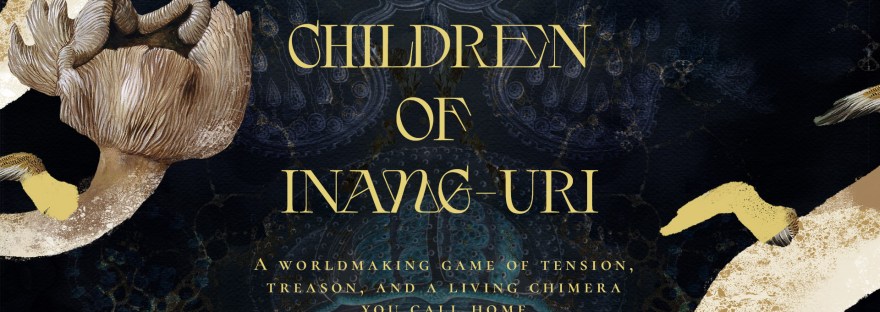
Written and laid-out by momatoes, The Marvelous Children of Inang-Uri is a 3-6 player game encouraging the co-creation of a setting through engrossing prompts across four in-game generations. Coming in at 64 pages, the zine guides players through building a rich world situated on Inang-Uri, a vast and majestic creature whose features, moods and behaviours are determined over the course of gameplay. Competitive, cooperative, and traitorous, Inang-Uri asks players to keep the chimera they call home alive – unless they’re the traitors aiming to see its downfall.
Overview
A worldmaking game of tension, treason, and a living chimera you call home, Inang-Uri sees players take on the roles of various factions who live on Inang-Uri. Unfolding across four generations and 4-6 hours, or two generations and 2-3 hours if you use the quick play version of the game, you will require a large piece of paper (or something like webwhiteboard.com), at least one d6, d8, d10, and d12, and many tokens (coins, stitch markers, toothpicks) per player (around 3-4 for quick play, and 5-6 otherwise).
Each generation follows three phases: Discovery, Initiatives, and Resolutions. The Discovery phase sets the scene for the generation: resources are reset, the world scenario is introduced, and community projects are determined, with each player has the chance to contribute to the world they are playing in and creating. The Initiative and Resolution phases are exactly what their names would suggest, with projects that resolve successfully gaining prestige for the factions that proposed and assisted with them. Importantly, successful projects also regenerate Inang-Uri’s health. As generations pass, the difficulty threshold for these projects to be successful increases, which I found a neat and simple mechanical way to illustrate the difficulties facing your home.
The game ends when you reach the end of the second/fourth generation, or when Inang-Uri dies – in which case the traitor(s) win. Prestige determines who the winning faction is, and while there is this competitive element to the game, players can’t forget to work together to keep Inang-Uri alive!
Highlights
I particularly appreciated that the Initiative phase does not allow players to take the same action for 2 consecutive rounds, thus forcing them to engage with one another at least once. Part of me feels that it should go without saying that players should be engaging with one another’s community projects, and working together to see them come to fruition, but I’m also always going to be in favour of the games rules going “and you are going to do that and not spend the game putting your head down and only advancing your own projects, this is a cooperative game too, not just competitive!”.
I also enjoyed how Inang-Uri’s general state of being changes from generation to generation and that while players could regenerate its health through successful projects, its health would still wane as various scenarios unfolded over time. As the game goes on, Inang-Uri’s health depletes and the threshold for successful projects increases, making it harder to keep your home alive and requiring the various factions to band together more and more. Reading over this was simultaneously stressful and hopeful: the odds might appear to be against you, but by coming together and supporting one another, there’s a continued chance for the future.
I love that players aren’t playing individual characters, but play as wider factions at work on Inang-Uri. I like that emphasis on community and playing to represent the goals and interests of a wider group, while also working towards a shared goal of continued survival. As the factions are chosen by the players I also think there’s a lot of potential to get a wide variety of interests represented, which would in turn impact how various scenarios are addressed and understood in diverse ways.
The layout of the game is also important to mention as it is beautifully done, and flipping through Inang-Uri feels like an experience in wonder itself. The seamless way quick play options are integrated makes running a shortened version of the game as easy as playing the full thing and having a sense of how long each version should take (2-3 hours for quick play, or 5-6 otherwise) was immensely helpful to me. I appreciate having an idea of how long a game should take, in part because it allows me to better prepare but also because I can look at the game, consider my attention span, and make a more realistic determination about which version will best suit the needs of both me and the rest of the table.
Conclusion
If worldbuilding games of cooperation and competition where you must balance the priorities of your faction with the wellbeing of your home over the span of generations appeals to you, The Marvelous Children of Inang-Uri might be for you! As much about strategy as it is about worldmaking, this latest work from momatoes offers riveting, story-driven moments against an increasingly tense backdrop as time goes on and the final moment of Inang-Uri’s life or death approaches.
The Marvelous Children of Inang-Uri is available on Itch for $16.00 USD. To keep up with momatoes, a Manila based 2022 Diana Jones Emerging Designer awardee best known for her game ARC, and for RPGSEA, a one-person project and database that gathers creative games from across Southeast Asia, find her website here. Creating games that tackle a wide range of stories, Inang-Uri is the second game of hers I’ve had the pleasure of reviewing and encourage everyone to give Astounding Tales and the Gods Who Sing Them a look if competitive 3-5 player storytelling games are of interest!
That’s all from me this time! Stay Cozy!
 The Cozy Cauldron
1 thought on “The Marvelous Children of Inang-Uri”