
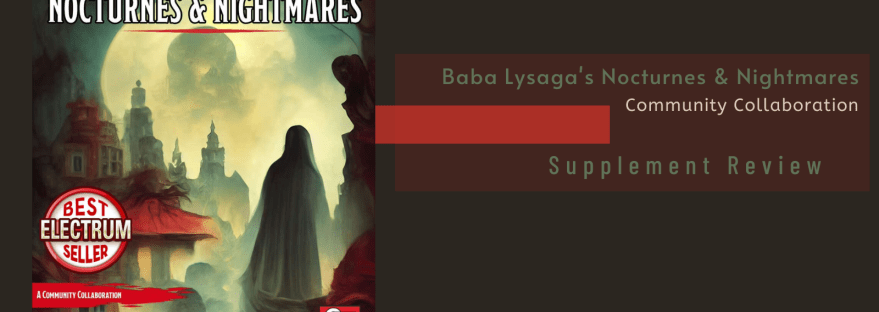
Are you looking to expand your collection of horror supplements? For inspiration on bringing some haunted spirit to your one-shot character? Maybe you’re looking for a fresh location to set your next adventure, or are looking for a different kind of item to reward your players with? Whatever the case, and even if you’re simply looking for a new supplement to read, Baba Lysaga’s Nocturnes and Nightmares has something for you. Whether a player or GM, new to the game or with years of games behind you, I have no doubt that there’s something in here for your horror loving heart.
Nocturnes & Nightmares is a gorgeous book whose layout and colour scheme make for easy, enjoyable reading. With over 110 pages of new content including subclasses, spells, items, adventures, locations, and tips for running horror, this is a truly valuable resource everyone involved should be proud of.
I went into this supplement knowing about the Pathologist (Artificer) and Banshee (Sorcerer) subclasses. I knew there were four new Domains of Dread, and two associated adventures. Adventures are always of particular interest to me as they’re what I most often make use of – especially considering that I only rarely run games in 5e myself. I was especially excited about this release, however, as Halloween is one of the times of year I reach out to my DMs and go “hey, want a break? I’ve got a one-shot!” (I’d already chosen my adventures for this year, and you’ll be able to read about those in November, but it is never too early to start thinking about next Halloween).
I was already excited about two subclasses, and the included adventures. Then I saw how many new spells there were and got excited all over again as I adore having new material to draw from for my myriad of casters!
This supplement is a community effort from Anthony Anderson, Danny Kodicek, Jackson Wagner, Bryan Cetroni, Anastasia Murray, Caspian Cavieri, and Colby Whittaker, with art from Adlaya’s Designs, MapleDragoon, and Alderdoodle. I received a complimentary copy for review purposes and will always be transparent about times where this happens! Big thank you to the entire team for giving me the opportunity, and especially to Bryan who has been my contact person from the start!
Baba Lysaga’s Nocturnes & Nightmares retails for $19.99 and can be purchased [here].
Part One: Twilight (Character Creation and Uncanny Magic)
Character Creation opens with a handy, easy to reference table of all the subclasses being presented, the class they’re associated with, and a brief description of what they’re about. I appreciate that rather than scrolling through multiple pages to remind myself of the basic idea behind a subclass, it is all presented in one place. Beautiful, I’m a fan. The Monstrous Lineages are creepy and unsettling, with the Living Puppet being exactly as unnerving as it sounds, and the Flymera being decidedly worse. They’re fun, and suggestions for where you’ve come from in the Domains of Dread are provided for each Lineage.
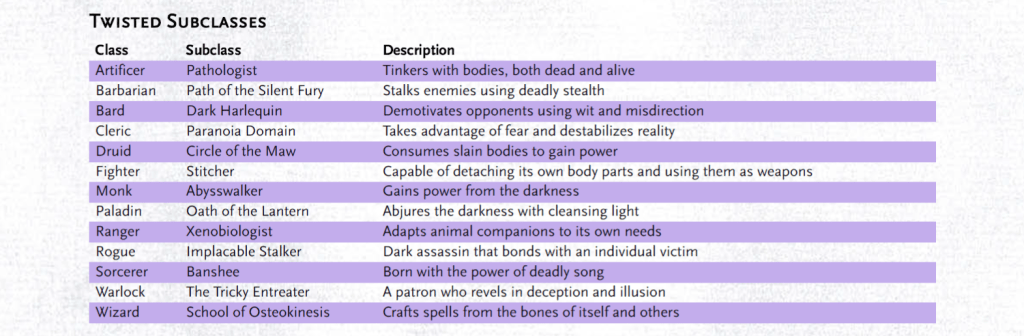
The Pathologist Artificer and Banshee Sorcerer already had my attention but the Paranoia Domain Cleric, with its description of taking advantage of fear and destabilising reality, immediately reminded me of a character I’ve been trying to settle on a subclass for – always exciting. I was also interested in the Path of Silent Fury Barbarian, specifically how Silence and Stealth become integral to the workings of the class. I found taking a class normally understood as being Loud when raging and instead envisioning it as utterly silent compelling. The sheer versatility of the School of Osteokinesis Wizard through class features immediately caught my attention and launched it into my top three favourites from these new additions. I enjoyed the option to craft various tools, gain a more flexible version of Armour of Agathys, recover spell slots in battle and, at higher levels, fly. No lockpick? No problem, we’ve got a bone for that.
I also instantly appreciated the presentation of these subclasses as not emerging “from a simple world of good and evil.” I’m a fan of morally grey characters, so having questionable morality built in made my story-loving heart sing. The chapter specifies that some have chosen their respective twisted paths, while others have been cursed with it – regardless of how the power came to these people, however, they’re likely to be mistrusted, no matter their intentions.
This makes things like the Paranoia Domain Cleric giving Disadvantage on Insight checks made against them (upon reaching 6th level), even more delightful. Similarly, the Xenobiologist Ranger’s companion creature has a range of customization options to make it both a literal nightmare, and a battlefield presence your foes will be thinking twice about. The idea of being in a party with this Ranger and seeing the changes made to its companion as you all level up made me laugh, and I think a party with a Xenobiologist and Pathologist would be quite entertaining!
As captivated as I was by all of these subclasses, my top two were the options for Sorcerers and Artificers. The Osteokinesis Wizard was a close third. Both the Banshee-born Sorcerer and Pathologist Artificer play into their respective class fantasies very well, both mechanically and narratively.
Spotlight – Sorcerer: Banshee
I need to spend a minute on the Banshee-born Sorcerer. Each time I’ve read it I’ve been filled with excitement all over again, in no small part because its mechanics so perfectly match the way I’m playing my Banshee character. Also, a feature called ‘Love Me And Despair’ immediately calls THAT Galadriel scene to mind and is there anyone among us who can honestly say that isn’t immensely cool?
Narratively, this class is fascinating. You’re Undead, and mechanically gain the ability to show your true face and Frighten people at level 6. Again, I was thinking of my character and how this mechanic translates so well into the story: she doesn’t show people her true face until she knows them better as, by and large, she doesn’t want to risk scaring potential new friends. Banshee-born Sorcerers know they’re feared – this is established in the subclass text – and they might rightly wonder if the party themselves will be (more) afraid of them after seeing their true face. Does this unmasking become something they try to do in benefit of the party without them knowing? Will dynamics shift after seeing their true face? Some might be fearful, but the sharing of that vulnerability might bring PCs closer together!
Spotlight – Artificer: Pathologist
I’ve played an Artificer once. It was all All Kobolds one-shot, one of my first times playing DnD, and overall, I didn’t know what was up. I’ve also never really felt inclined to play another Artificer… until now. The Pathologist gives you a Carrion Cart at 3rd level which allows you to provide partial cover for allies, is a noxious centre of poisonous fumes, and can even heal itself or an ally! At higher levels it can confer further benefits to nearby allies, and it can carry up to 500lbs from the get-go!
I was reminded of A Plague Tale: Innocence and liked how this class is focused on spreading contagion through Necromantic spells. I particularly enjoyed how it immediately lends itself to creating a background for your character. What came to mind for me was, if starting at Tier One, a character who is either just finishing up an apprenticeship or is about to finish one before heading out into the wider world with their brand-new cart! Adventure, and corpses, await!
Chapter two, Uncanny Magic, begins with a table of all twenty new spells, organised by level. I thought it was curious that of the twenty, only two of the spells are from the school of Necromancy – I would have expected more than that! It works out to two new spells per spell level, with a total of fourteen new options for Sorcerers, and ten for Clerics. Those two classes got my attention in this chapter entirely because I was window-shopping spells for two of my characters who are, as you may have guessed, a Sorcerer and Cleric respectively.
Contrary to the table presented, the descriptions of spells are presented in alphabetical order. This is pretty standard and while I understand why books present them this way, I personally prefer getting to read about them in order of power – I just find it easier to reference. Now for a little bit more about those new spells…
Bunsen Burner is a Cantrip which, on its own, isn’t doing much more than offering the light of a candle. In specific environmental situations, or with some planning within the party, however, this Cantrip has the possibility of setting off a particularly nasty and damaging chain of events to slow enemies and whittle down their health before they’re properly aware of where your party even is.
Confident Victory, a 6th-level illusion spell, is downright nasty and again, with some planning, could be used to deal significant amounts of damage to a group of enemies if paired with other area of effect attacks. What I like most about this spell is that unlike other Charm effects it actively encourages you to keep attacking the charmed creature(s), while its specific conditions encourage different ways of utilising it to help control the battlefield.
Haunt is an incredible narrative spell. A 5th-level abjuration (ritual), its effects last until dispelled and aside from useful battlefield application I was thinking of the party’s reputation, and how maybe there’s a haunted location left everywhere they’ve travelled to. It’s a great way to keep unwanted guests away, and offers options to trap creatures within the area, give your sunlight sensitive friends some reprieve, and more!
Rattlebones is a 4th-level divination spell which has you crafting an item that can be worn by you, or another creature. Its effect lasts for 8-hours, and there are four options to choose from including one which benefits everyone within a (generous) range. Because you just need the materials and spell slot to cast it, there is no reason that if your party splits both groups can’t benefit from its effect, making this an especially powerful spell when exploring dangerous locations where your party otherwise might be met by unpleasant surprises.
Finally, I’m not saying that 4th-level necromancy spell Shivering Touch is particularly useful for bringing down a building or other type of structure, butttt when the spell specifically mentions what happens when you use this spell on a building, it sure brings ideas to mind. You can also use this spell to confer damage weakness to a creature, which is cool, but I’m still thinking about bringing down the house.
Part Two: Dusk (Nightmare Domains and Cursed Adventures)
With the second section of Nocturnes & Nightmares we move from the comforting purple of twilight to the deep, dark orange of dusk. The change of colour scheme is lovely at an aesthetic level, but also for finding your place in the book if quickly scrolling through! Like the previous chapters, this one opens with a summary of what is to come – in this case a summary of the four Domains of Dread, demiplanes of pain and terror, found within Baba Lysaga’s tome. In addition to a summary of what to expect from the Domain, it also tells you what genres that plane encompasses. For example, The Gloom: An Existential Tragedy, falls within psychological horror, while Hex: Covens in Conflict draws on folk horror and dark fantasy. I find this particularly useful as it lets you see at a glance which Domain is going to best suit the tone of your game and, by the same token, which one(s) to steer away from based on your group’s comfort.
As with all horror, you need to take particular care when running and playing in it. I was immediately captivated by The Gloom as a potential setting – working with the fears and trauma of PCs can offer rich story opportunities, and even a chance for healing. This is a location I would take a lot of care in both with the PCs, and my players. Of the four its overarching despair has, I think, the greatest chance of bleeding from the game to the wider table. The creators are very aware of the content within the volume, however, and there is an entire section of the book dedicated to running horror that adds a level of compassion and responsibility to the supplement I deeply appreciate (more on this when we get to Part Four: Dawn).
I enjoyed the variety of the demiplanes and their presentation. The Gloom included a one-page story which made me misty. Hex included a section on how to individualise the covens, and some key locations within their respective territories, in addition to a roll table of possible adventure hooks. In Psedolop, meanwhile, a disease with an unknown source spreads and villagers are likely to be wary of the party on arrival – disease and death is a real possibility here, and the mention to ensure these themes are ones the group is interested in is well-placed. Finally, Kachelior offers a tale of a place that was once a paradise, turned into a hellish plane of existence. Sacrifice throughout generations has almost freed this Domain of the four Archfiends who invaded and took it over, but Kachelior is not yet free and only one settlement, Grey Shade, remains.
Which brings us into Cursed Adventures! Nocturnes & Nightmares comes with two adventures, one for Tier 1 characters (set in Hex), and the other for Tier 3-4 characters (in Kachelior). In the same way that Tier 1 adventure are for Player Characters just getting started in their journeys, ‘Night of the Scarecrow’ is designed as more of an introduction to the terror-filled Domains found within Baba Lysaga’s book. The Kachelior adventure (‘The 13th Circle) is, meanwhile, better suited to characters – and players – well versed and familiar with the horrors of these realms. Of the two, the Hex adventure speaks more to my personal tastes – I like the inspiration it takes from Vasilisa the Beautiful – but both are, in themselves, interesting ideas.
Part Three: Midnight (Haunted Treasures & Creatures of Darkness)
You know that magic items and monsters in a horror supplement are going to be fun, and Nocturnes & Nightmares does not disappoint! The items introduce an affiliation called “cursed consumables,” a mechanic which gives players the option to access great power… at a cost. I’m all about this. In general, I love magic coming at a price and it’s something I explore with my characters at almost every given opportunity.
Back when I was doing vendor RP in World of Warcraft, a lot of the items my character sold had drawbacks of some kind. It was always interesting to see not only who would think XYZ was worth the cost, but how the consequence would wind up playing out and or be planned around. I love giving players these kinds of choices, just as much as I enjoy having them handed to me!
For example, there’s an item which allows the possibility of dealing 1d100 damage (or more, depending on certain conditions). That can swing wildly, as we well know but if it works out in your favour… that’s a huge boon. But is it worth it if you also take 1d100 damage? You could roll high for the damage you take, and low for the damage you deal. It’s a risk, and I love it. Under what circumstances would your character take the risk?
There’s also a lantern that gives darkvision when it’s lit. The extra whispers you’re hearing are just an ambient effect, and everything will be fine when you eventually extinguish it. Probably. Maybe. Not knowing is part of the fun!
Next come our monstrous friends, and with over thirty to peruse from across all four domains, there’s plenty here to use in the settings offered within these pages, and those beyond. Some are specifically mentioned in the adventures provided in Chapter Four, while others just exist! There’s a nice mix of creature types and ratings, with some gorgeous art to accompany some of the more prominent monsters.
I was particularly fond of the Dazzle Bat, which isn’t so different from other bats except in the way it hunts! In addition to being a neat creature to fight against, I think there’s a fun possibility for any druids in the party to pick up a new wildshape. And if beasts aren’t your thing, don’t you worry, you can always fight a physical embodiment of grief!
Part Four: Dawn (Running Horror)
This was a nice treat to have included at the end of the book, and one I especially appreciated given the content. As I mentioned earlier, including a section on how to run horror – starting with setting expectations and tools to maintain a safe table – is something I deeply appreciate. In addition to talking about table safety, this section also includes useful suggestions and remarks for running horror in general. I sincerely believe that DMs of any experience level will benefit from giving this section a read and keep what’s said in mind not just for horror based games, but in general. It was a nice way to round off a book filled with creeptacular delights and spooky surprises.
Final Thoughts
This heading makes it sound like I have an actual direction here, and not like my thoughts are scattered and scampering in several directions as my brain takes off with both character and story ideas. In no particular order:
– I really enjoy how Baba Lysaga is telling a young Strahd a story throughout the book and getting to witness these little bits of advice and stories unfold. It’s incredibly effective in setting up who Baba Lysaga is, and quite unnerving to remember that “oh, right, this is Strahd. Like. That Strahd. Hm.”
– Colour schemes! The changing colours and associated are spreads between each part of the book was visually appealing and a great organisational cue. The Table of Contents is fully linked, which also assists in navigation, and as someone who frequently uses two-page view, I appreciated how nicely it worked in this format.
– Variety: there’s so much in this volume and I’ve recommended it to DM friends of mine already as a “hey even if you aren’t looking to add new things to your game, this is a GREAT read”. The timing of the release for the end of October was such a smart choice since, as the title suggests, this release is well geared to supporting horror filled games, adventures, and one-shots which tend to see a bit of an uptick at this time of year!
– I want to play a Banshee sorcerer so badly, and if I play the Pathologist Artificer I need to have the Bunsen Burner cantrip to see if I can set off explosions with the noxious fumes from my corpse cart. I’ve been thinking about this for days.
– My favourite supplements are the ones where my brain runs away with me, creating or solidifying character concepts, or weaving stories about adventuring parties, their dynamics, and adventures. Nocturnes & Nightmares did this in the first chapter.
Whether player or GM, horror newbie or aficionado, Baby Lysaga’s Nocturnes and Nightmares has something for you! You can find this best-selling supplement for $19.99 [here]. What are you most excited about within? Is there a subclass you’re dying to try? Which location speaks to you most? Let me know below!
Like this review? Want to help the Cauldron keep on bubbling? Become a Cauldron Companion on Ko-fi or Patreon!
 The Cozy Cauldron
3 thoughts on “Baba Lysaga’s Nocturnes and Nightmares”